Investment Strategy
Look closely at where the world puts its research dollars and you find a striking gap: many of society’s biggest problems don’t have society’s biggest R&D budgets.
Powerful engines exist to fund medicine, the physical sciences, and engineering—fields where investment reliably turns ideas into impact. The problems social science can address, from the labor market impact of AI, to the challenges of strengthening democracy, to the erosion of economic opportunity, carry equally high stakes, yet only draw a fraction of that commitment.
Research-driven successes in fields like medicine often share a key ingredient: serious, sustained investment that grants researchers and their collaborators room to do hard things. When funding is substantial enough to take on big problems, patient enough to see them through, free enough to follow the evidence wherever it leads, and bold enough to bet on ideas that might fail—because the ones that succeed can change millions of lives—science can drive meaningful impact.
Social science has rarely been backed that way.
We aim to change that at a moment when new technology is making social science faster, more responsive, and more powerful than ever before—raising the payoff of serious investment. At Stanford Impact Labs, we advance our mission of putting social science to work for society by funding a portfolio of research that has a clear and direct path to impact, including through research on specific solutions; generating knowledge that can shape markets or policy; and other targeted responses to pressing societal needs.
What We Fund
We invest in field-leading social science with a credible path to real-world change. Every investment clears the same demanding bar: rigorous, actionable research; a clear path from science to impact; sustained engagement beyond the university; and clear demand from the institutions, policymakers, and communities the work aims to serve.
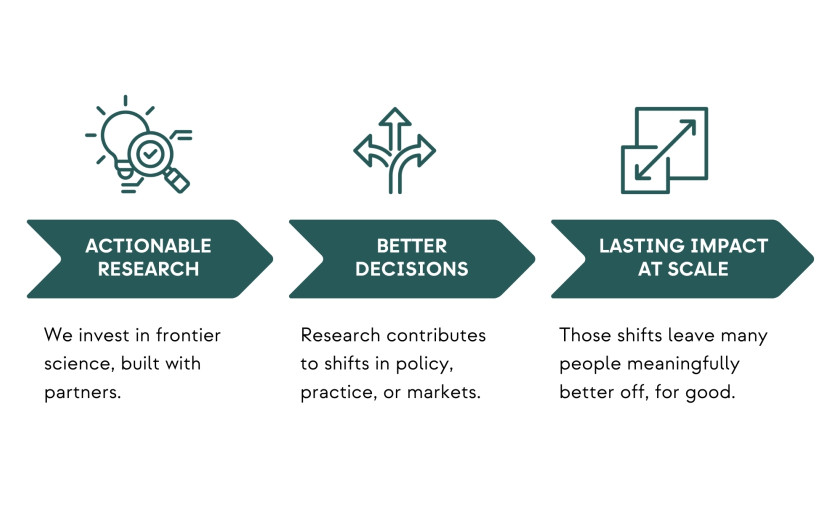
Our logic is simple: actionable research changes decisions, and better decisions yield lasting impact at scale.
As a university-wide initiative based in the School of Humanities and Sciences, we have the flexibility to fund Stanford's strongest impact-focused social science across domains such as education, health, economic opportunity, and democracy.
How We Invest
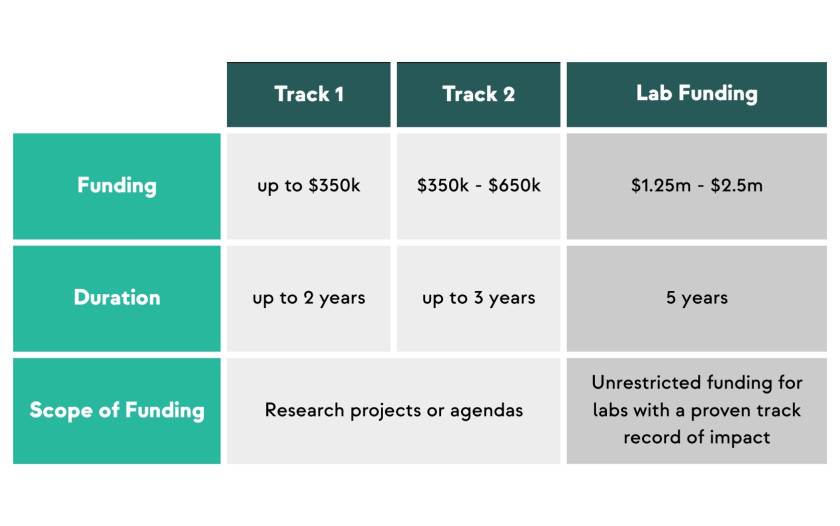
Each of our funding opportunities is defined by progressively larger budget amounts, durations, and research scope. Larger investments are matched by higher expectations for the magnitude of scientific contribution, the impact a team is positioned to achieve, and the level of engagement or partnership. Track 1 and 2 support research projects and agendas. Lab Funding is distinct: it provides unrestricted long-term support for teams with a proven track record of impact. We consistently hear that this type of support is rare and enables teams to be responsive to opportunities for even greater impact.
We intentionally invest in a diversified portfolio of research spanning a range of risk-return profiles. Some studies build steadily on established knowledge; others explore more uncertain, high-upside questions. By combining steady knowledge-building with bold inquiry, we strengthen both the reliability and the transformative capacity of the social sciences.
The teams we fund often face common challenges. Our strategic support services are designed to help clear those challenges and accelerate the impact of the research. When we invest, we seek a return: not in money, but in results that improve people’s lives. We hold ourselves accountable for that return, measuring whether the research we fund actually shapes decisions and improves lives.

Stories from our Portfolio
With funding from Stanford Impact Labs, researchers at Stanford RegLab used an AI tool to scan 500 million words of state statutes across all 50 states, revealing rapid growth in reporting requirements and helping New York, California, and Maryland begin cutting outdated “policy sludge.” Learn More

Working to bring data and evidence to the fight against human trafficking, the Stanford Human Trafficking Data Lab built a satellite-based tool that helped law enforcement officials in Brazil find nearly 200 hidden illegal charcoal sites and rescue forced laborers. Learn More

Stanford's Stephen Luby and Boston University's Nina Brooks discuss their published research on how to make environmental progress in unregulated settings. Learn More

The Stanford History Education Group (SHEG), a digital literacy research initiative becomes the Digital Inquiry Group (DIG), an independent nonprofit. Learn More

Stanford’s Global Capital Allocation Project (GCAP) and the European Central Bank (ECB) use large-scale data to examine how and where capital flows. Learn More
